

How we help
Senior technology expertise, exactly where decisions matter.
Services describe how we advise and lead; our Solutions describe what we build. Choose the kind of help you need — a decision, leadership, a defined product, a transformation, a programme lead or a sound start with AI.
Six ways we work with you
01Featured service
Technology Consulting & Strategy
Independent technology judgment, applied before you commit budget, vendors or years of work.
Most expensive technology problems begin as unmade decisions: which platform, which vendor, build or buy, what first. We help leadership make those decisions in business terms and write down why.
The work is structured and independent. We assess what exists, compare real options with their trade-offs, and leave you a decision record and a phased roadmap that your board, partners or delivery team can read without us in the room.
We stay brand-neutral on technology and honest about what to leave alone. When a build is the right answer, our Solutions can deliver it, or a partner you choose can.
Typical questions
- Direction, priorities and investment sequence
- Build, buy or integrate decisions
- Platform and vendor selection
- Current-state review, risk and readiness

02
Fractional CTO & Technology Leadership
Senior technology leadership at part-time scale: the recurring decisions on strategy, architecture, vendors and delivery standards, owned alongside your team. “Fractional” describes the engagement model, not the seniority.
Fit and non-fit are stated plainly, and engagement models are agreed case by case. Nothing here is a commitment to a named person, hours or a staffing level.
Explore Fractional CTO
03
Product Discovery & Architecture
Define what to build, and how, before building it. Discovery and architecture surface conflicting assumptions, test user journeys and fix scope while changing course is still cheap.
You leave with a product brief, journeys and prototype, an architecture view and a prioritized backlog that any capable team can pick up.
Explore Product Discovery- Processes as they really run
- Systems and integration debt
- Data ownership and trust
- People, owners and adoption
04
Digital Transformation Advisory
Modernize the business, not only the software. We diagnose how work really flows across processes, systems, data and people, then sequence change your organization can absorb.
The advice stays independent of whoever implements it, so the plan serves you rather than a vendor.
Explore Transformation Advisory- Scope and milestones
- Quality gates and acceptance
- Risks and dependencies
- Vendor and team coordination
05
Technical Project Leadership
One accountable lead for a technical program: scope, delivery cadence, quality gates, risks and vendors, from kickoff to production, or through a rescue.
Bounded to a named initiative. It does not replace your technology strategy or your engineering team.
Explore Project Leadership
06
AI Consulting & Implementation
Use AI where it genuinely helps, and nowhere else. We triage use cases, pilot with human oversight, integrate with the systems you already use and hand over something your team can supervise.
Advice and delivery are kept distinct, so you can take our recommendation elsewhere or ask us to implement.
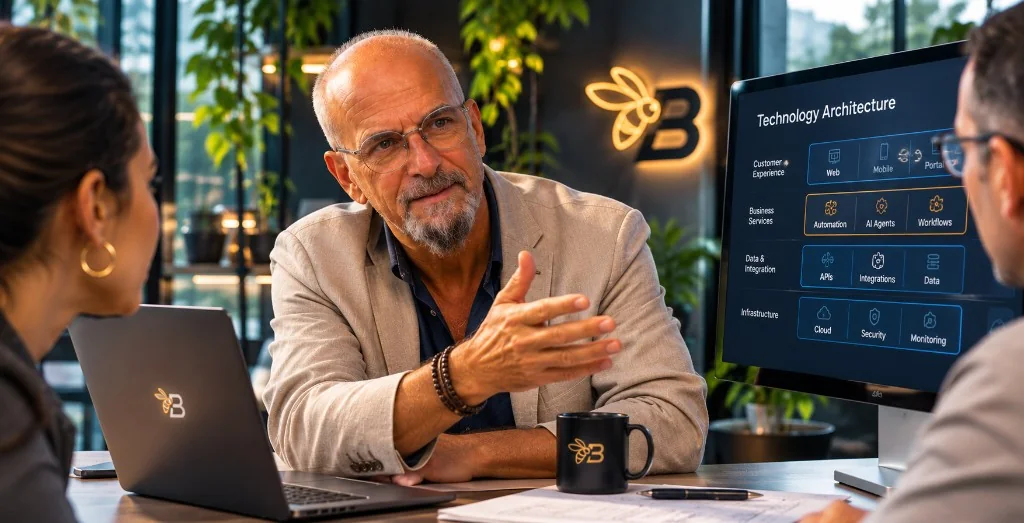
Explore AI ConsultingPhotographs on this page are conceptual illustrations. They do not show BWAYS staff, clients or engagements, and imply no staffing commitment or result.
Want to compare the six services before choosing one?Read the complete services guide
Looking for what we build rather than how we advise?See our Solutions
Engagement
Work with us your way.
Three common patterns, combined or on their own. No fixed public packages or implied staffing levels.
Advisory engagements
A defined question, a clear output and a clean end: strategy, discovery, architecture or an AI starting point.
Embedded leadership
Part-time senior leadership or a programme lead who works alongside your team over months.
Guided delivery
Independent oversight while you or your partners build, with BWAYS Solutions available when a build is the right answer.
Why BWAYS
Business judgment backed by engineering depth
We are an international business and technology partner — not an AI novelty shop.
Business first
Technology choices follow operational reality, not the other way around.
Founder experience
David Edelman (“Dacho”) brings 30+ years of personal practice across software, business, and consulting — that is individual experience, not company age.
International operations
Primary operations in Costa Rica since July 2021, with Israeli business representation for selected needs — not a published Israeli HQ or headcount claim.
Maintainable outcomes
We optimize for what you can operate after we step back: clarity, records of decisions and honest documentation.
In depth
A Deeper Look at How We Advise and Lead
Choosing a technology partner is rarely a single decision. A business that says it needs “an app” may really need a clearer decision, a leader who owns the outcome, or an honest answer to whether it should build at all. This guide explains the six ways BWAYS advises and leads, what each involves in practice, and how to tell which one fits the problem in front of you.
It is written for owners, operators and technical leaders who want to compare options before speaking with anyone. It contains no statistics, client results or promises about rankings. Where we use examples they are hypothetical and labelled as such. Services describe how we advise and lead; what we build is described under Solutions. Each chapter ends with a link to the full service page.
Which service fits which situation
A quick comparison. Most real engagements combine two or three of these.
| Service | Start here when… | Typical output | Often combined with |
|---|---|---|---|
| Technology Consulting & Strategy | A major technology decision carries real cost or risk. | Decision record, context map, roadmap outline, risk register | Product discovery, transformation advisory |
| Fractional CTO & Technology Leadership | Technology decisions keep recurring and nobody senior owns them. | A standing mandate, decisions on record, a steady cadence | Consulting, project leadership |
| Product Discovery & Architecture | The idea or the requirements are still unclear. | Product brief, journeys, prototype, architecture view, backlog | Consulting, project leadership |
| Digital Transformation Advisory | Operations, systems and data have outgrown how the business works. | Baseline, prioritized changes, phased roadmap, adoption plan | Consulting, AI consulting |
| Technical Project Leadership | A technical program needs one accountable lead, or has stalled. | Delivery cadence, risk register, decision log, handover pack | Fractional CTO, discovery |
| AI Consulting & Implementation | A repeated task could be supported by AI under supervision. | Triaged use cases, supervised pilot, evaluation, handover | Transformation advisory, consulting |
01
Technology Consulting & Strategy: decisions made in business terms
Technology consulting is independent, structured judgment applied before money, vendors or years of work are committed.
- Best suited to
- A defined decision that carries real cost or risk
- Typically produces
- A decision record, a context map and a phased roadmap outline
- Often paired with
- Discovery to define the product, or advisory for wider change
What the work involves
The work starts with the business: objectives, constraints and what success means operationally. We then review the systems, data and people as they are today, set out real options with their trade-offs, and record the recommended direction in a document that someone who was not in the room can follow.
When to consider it
Consider it when the need is clear but the path is contested, when internal teams are too close to legacy constraints, when vendors each optimize for their own product, or when a major platform decision is approaching. It is also a sensible first step when growth is straining systems nobody fully owns.
Common challenges
Decisions are often made before the question is framed. Cost is judged by the purchase price instead of the cost of ownership. Integration debt is discovered late, and the people who must adopt the result are consulted last. A good engagement surfaces these early, when they are cheap to address.
Decisions and trade-offs
Building gives control and fit but carries maintenance; buying is faster but constrains you to a vendor’s roadmap; integrating is cheaper until the connections multiply. There is rarely a right answer in the abstract, only a right answer for your capacity, risk appetite and timeline, which is what the work makes explicit.
Typical activities and deliverables
Activities include stakeholder interviews, current-state review, option comparison, risk and security notes, and roadmap sequencing. Deliverables can include a decision record, a context map, a phased roadmap outline and a risk register. None is a fixed package or a guaranteed timeline.
Common mistakes and misconceptions
A common mistake is asking a vendor to evaluate its own product. Another is treating strategy as a slide deck instead of a decision someone owns. And advice that never says “do not build this yet” is probably not independent.
How it connects to our other services
Consulting often leads into product discovery once a direction is chosen, and into transformation advisory when the change spans operations. When the need becomes continuing leadership, see fractional CTO. If the answer is to build, our custom software solutions or a partner you choose can deliver it.
02
Fractional CTO & Technology Leadership: senior ownership, part-time
A fractional CTO is a senior technology leader who takes ongoing responsibility for a defined mandate at part-time scale. “Fractional” describes the model, not the seniority.
- Best suited to
- Recurring technology decisions with nobody senior to own them
- Typically produces
- A standing mandate, decisions on record and a steady cadence
- Often paired with
- Consulting beforehand, project leadership for specific programs
What the work involves
The mandate is agreed in writing and fitted to your stage: technology strategy, architecture decisions, hiring standards, vendor selection and oversight, delivery practice, and the security and continuity answers investors or auditors ask for. The leader decides and is accountable; your team or vendors build.
When to consider it
Consider it when technology is central to growth but nobody on the team carries executive-level responsibility for it, when a technical lead has left, or when decisions recur faster than a one-off project can cover. It also gives you a senior counterpart facing agencies and suppliers.
Common challenges
The role fails when it has responsibility without authority, when the mandate is vague, or when the leader is treated as extra engineering capacity. Part-time presence also demands good written decisions and a predictable rhythm so that nothing waits for the next meeting.
Decisions and trade-offs
A fractional leader is cheaper than a full-time executive but is not always available. A full-time hire brings daily presence and a permanent commitment. The honest question is how much senior attention the business needs now, and a good fractional leader will tell you when that has outgrown the model.
Typical activities and deliverables
Activities include orientation, decision-making on blocked questions, written rationale, hiring and vendor reviews, and regular reporting. Engagement models are agreed case by case: time-bound leadership, sustained leadership or transition cover. Nothing here is a commitment to a named person, hours or a staffing level.
Common mistakes and misconceptions
A common mistake is hiring a fractional CTO to write code. Another is expecting leadership without giving the role decision rights. It is also a misconception that fractional means junior, or that it is always a stepping stone to a full-time hire.
How it connects to our other services
Many relationships begin with technology consulting and grow into leadership. For a single initiative rather than the whole company, see technical project leadership. Leadership often directs product discovery and frames AI adoption. See our custom software solutions for what we build.
03
Product Discovery & Architecture: decide what to build before building
Discovery and architecture turn an idea or a vague requirement into something a team can build and a business can operate.
- Best suited to
- An idea or requirement that is still unclear or contested
- Typically produces
- A product brief, journeys, a prototype, an architecture view and a backlog
- Often paired with
- Consulting before, project leadership or a build after
What the work involves
We listen and map how work happens today, frame the problem with users, tasks and constraints, and shape journeys and scope with prototypes. Architecture then fixes the shape of the system: data, integrations, security and how it will be operated. User experience is part of discovery, not decoration.
When to consider it
Consider it when stakeholders describe different products under the same name, when a build estimate is mostly guesswork, when users must complete tasks across several systems, or when a prototype would settle an argument that meetings have not.
Common challenges
Teams skip discovery to save time and pay for it in rework. Requirements describe solutions instead of problems. Architecture is chosen before data and integration realities are known, and accessibility and quality expectations are left until the end.
Decisions and trade-offs
A narrower first version ships sooner but leaves valuable work for later. Rich prototypes reveal more but take longer. Building on a platform saves effort while limiting what you can change. These trade-offs are written down so that they are chosen rather than inherited.
Typical activities and deliverables
Activities include workshops or interviews, journey mapping, prototyping, architecture design and prioritization. Deliverables can include a product brief, journeys and a prototype, an architecture view and a prioritized backlog. The architecture view is conceptual unless verified against your real systems.
Common mistakes and misconceptions
A common mistake is treating discovery as a delay rather than as the cheapest stage to change course. Another is expecting a prototype to be a first release. And outputs are not locked to us: they are written to be handed to any capable team.
How it connects to our other services
Discovery usually follows technology consulting and is led through delivery by technical project leadership. It feeds AI consulting when a workflow is a candidate for automation. When a build begins, our custom software solutions or your chosen partner take the backlog forward.
04
Digital Transformation Advisory: modernize the business, not only the software
Transformation advisory diagnoses how the business really works and sequences change your organization can absorb.
- Best suited to
- Operations, systems and data that have outgrown the business
- Typically produces
- A baseline, prioritized changes, a phased roadmap and an adoption plan
- Often paired with
- Consulting for decisions, AI consulting for specific workflows
What the work involves
We look at four things together: processes as they really run, the systems that support them, the data that moves between them and the people who own and adopt the change. From that baseline we rank candidate changes by value, effort and risk, and arrange them into a phased roadmap.
When to consider it
Consider it when reports do not agree, when month-end is a reconciliation exercise, when each team keeps its own tools, or when an earlier program changed the software but not the way people work. It is also useful before committing to a platform replacement.
Common challenges
Programs begin with a platform and discover afterwards that the underlying processes were never agreed. Data is inconsistent, ownership is unclear, and the people who must adopt the change were not involved. Looking at only one of the four areas is the most common reason change disappoints.
Decisions and trade-offs
A large coordinated change can look efficient but concentrates risk; small steps deliver sooner but need discipline about the end state. Standardizing processes reduces cost while removing local flexibility. The advisory work makes these trade-offs explicit and keeps decision points before each larger commitment.
Typical activities and deliverables
Activities include process and system mapping, data review, priority setting, roadmap design and support while the plan meets reality. Deliverables can include a baseline picture, a ranked list of changes, a phased roadmap and an adoption plan. Savings or results are never promised.
Common mistakes and misconceptions
A common mistake is equating transformation with buying software. Another is leaving adoption to the end. And it is a misconception that advisory work implements the change: building belongs to Solutions or to another partner.
How it connects to our other services
It builds on technology consulting for individual decisions and may call for technical project leadership during execution. Specific workflows can be taken forward as AI consulting. For building, see our automation solutions and custom software solutions.
05
Technical Project Leadership: one accountable lead for the program
Technical project leadership puts senior judgment in charge of scope, delivery, quality, risk and vendors until the work is in production, or back on track.
- Best suited to
- A named technical initiative that needs one accountable lead
- Typically produces
- A delivery cadence, a risk register, a decision log and a handover pack
- Often paired with
- Fractional CTO for the wider mandate, discovery up front
What the work involves
The lead aligns on the outcome and who decides what, breaks the work into increments with owners and acceptance criteria, keeps cadence and unblocks teams, and hands over with documentation and a clear owner. It covers scope and milestones, quality gates, risk and dependency tracking, and coordination of internal teams and vendors.
When to consider it
Consider it when a program involves several teams or suppliers and nobody answers for the whole, when decisions wait for meetings, when risks are found late, or when a program is behind, over budget or stuck in disagreement and needs an honest reset.
Common challenges
Responsibility is spread so thinly that no one holds it. Vendors blame each other’s interfaces, acceptance criteria are vague, and status reports describe activity instead of progress. A rescue also has to deal with promises already made that cannot be kept.
Decisions and trade-offs
Tightening scope protects the date but disappoints some stakeholders. Adding people late rarely speeds a program up. A rescue may mean stopping part of the work to save the rest. The lead’s job is to make these choices visible and to record who made them.
Typical activities and deliverables
Activities include planning, regular decision reviews, quality checks, risk management and vendor coordination. Reporting is in plain language: status, a decision log, a living risk register and a handover pack. The lead directs delivery rather than writing the code.
Common mistakes and misconceptions
A common mistake is expecting a project lead to fix a strategy problem. Another is appointing a lead without decision rights. And leadership is not a substitute for engineering capacity: someone still has to build.
How it connects to our other services
It differs from fractional CTO in scope: one initiative rather than the company’s technology as a whole. It often starts from product discovery outputs and supports transformation advisory during execution. Building can come from our custom software solutions or other partners.
06
AI Consulting & Implementation: use AI where it helps
AI consulting finds the uses that genuinely help, and implementation brings them into real processes with human oversight.
- Best suited to
- Repeated tasks whose output a person can check
- Typically produces
- Triaged use cases, a supervised pilot, evaluation and a handover
- Often paired with
- Transformation advisory for the wider process, consulting for decisions
What the work involves
We map the real workflow, score candidate use cases by value, feasibility and risk, and choose one. A narrow pilot is built and tested on real cases with people reviewing results, then integrated with the systems you use, with access controls and sensible fallbacks, and handed over with documentation and training.
When to consider it
Consider it when a team repeats the same task all day, when knowledge is locked in documents nobody can search, or when leadership wants “an AI agent” without a view of what it should be allowed to do. Triage is as useful for deciding what stays manual as for choosing what to automate.
Common challenges
Many AI projects stop at a roadmap, or deliver a demonstration that does not survive real data. Processes nobody has written down cannot be automated safely, data may be incomplete or restricted, and results degrade unnoticed when nobody is measuring them.
Decisions and trade-offs
More automation saves effort but reduces human review; more review is safer but slower. Hosted models are quick to start while raising data-handling questions. Broader access makes an assistant more useful and increases what can go wrong. These choices are made explicitly before building.
Typical activities and deliverables
Activities include use-case triage, a supervised pilot, integration, evaluation against cases from your real work, monitoring design and training. Deliverables can include a triaged list of use cases, a documented pilot, an evaluation set and operating notes. We do not promise accuracy or savings figures.
Common mistakes and misconceptions
A common mistake is starting with the model instead of the task. Another is treating a demonstration as a deployment. And AI is not a replacement for fixing a broken process; sometimes a simple rule or a better form is the honest recommendation.
How it connects to our other services
It pairs with transformation advisory when AI is one part of a wider change, and with technology consulting for platform decisions. Concrete builds are described under Solutions: AI voice and AI agents. Leadership for a rollout is covered by technical project leadership.
Where to start
If you are unsure, begin with the question you cannot yet answer.
“We face a major technology decision.”
Technology Consulting & StrategyCompare the options and their trade-offs before committing budget.
“Technology decisions keep landing on nobody.”
Fractional CTO & Technology LeadershipPut senior, accountable leadership over the recurring decisions.
“We have an idea but not a clear product.”
Product Discovery & ArchitectureClarify users, journeys, scope and architecture before development starts.
“Our operations have outgrown our tools.”
Digital Transformation AdvisoryDiagnose processes, systems and data, and sequence change you can absorb.
“A technical program is drifting.”
Technical Project LeadershipPut one accountable lead over scope, quality, risk and vendors.
“We want to use AI but are not sure where.”
AI Consulting & ImplementationFind the tasks where AI helps, and design the oversight around them.
Not sure which one describes you? That is normal, and a conversation is often the quickest way to find out. Tell us what you are trying to achieve and we will suggest the most useful first step — which is sometimes not to buy anything yet.
Discuss Your ProjectStart a conversation
Tell us where you need expertise
Whether you need leadership, a decision or a programme lead, we will route you to the right first step.