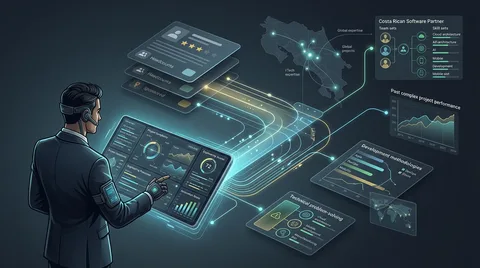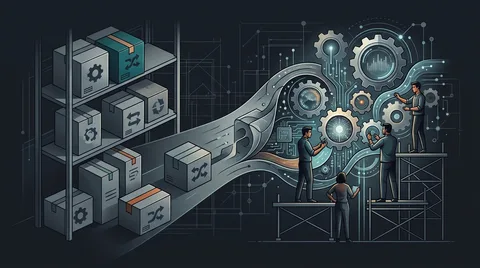


Selecting a partner for Costa Rica AI automation agency software development requires evaluating architectural rigor, data boundaries, and long-term maintainability over superficial tool assembly. Thin automation scripts often link disparate cloud platforms without verifiable error handling, transactional boundaries, or durable storage. When those superficial setups break under production volume, business workflows stall, customer records drift out of sync, and engineering teams inherit fragile dependencies that resist maintenance.
At a glance
- 12 min read
Ask us about this
Tell us what you are working on. We reply by email.
Discuss Your ProjectThis guide addresses chief technology officers, operations heads, and business leaders operating in Costa Rica who are evaluating technical vendors. It distinguishes superficial wrappers from production-grade custom software architectures engineered for local and regional workflows.
The analysis does not offer commercial guarantees, legal determinations, or universal timeline promises. It provides an engineering assessment of how system boundaries, monitoring layers, and disciplined development practices separate dependable operational software from brittle, stitched-together automations.
The Convergence of AI Automation and Custom Software in Costa Rica
Modern commercial operations in San José and across the Central Valley face a distinct operational transition. For several years, organizations addressed routine bottlenecks by stitching isolated scripts together, using third-party webhook aggregators or unmonitored scripts to shuttle data between spreadsheets, chat channels, and hosted databases. While these early experiments proved that automated steps save administrative hours, they also introduced silent state corruption, unmonitored payload drops, and fragile endpoints whenever underlying vendor interfaces changed without notice.
Bridging Scripting and Production Engineering
Relying on ad-hoc automation scripts quickly exposes structural limits when transaction counts rise or core financial workflows enter the loop. Mature enterprises find that script-level handlers lack the circuit breakers, queueing architectures, and audit logs required to protect operational continuity. When an unhandled error halts a background task, teams often discover the failure only after billing records diverge or regional customer requests go unanswered.
The conversation surrounding a costa rica ai automation agency software development partner has therefore turned toward full-lifecycle systems engineering. Production-grade execution requires treating language models, automated pipelines, and external integrations as integrated components within a unified backend architecture. Instead of dangling fragile scripts between off-the-shelf software tools, engineering teams build modular services that enforce strict data validation, isolate execution environments, and maintain verifiable event trails across the entire operational chain.
Why Scripted Wrappers Fail Production Demands
Off-the-shelf automation platforms and uncompiled trigger scripts often present a quick path to functional prototypes, yet they break down under real commercial strain. When workloads surge, these lightweight visual connectors encounter strict API rate limits, silent webhook failures, and unhandled schema drift from third-party services. Without explicit state management, a single stalled response can leave downstream database tables corrupted or customer records partially updated across external systems.
Enterprises evaluating a costa rica ai automation agency software development partnership frequently discover that visual wrappers lack essential system primitives: granular error handling, regression testing suites, asynchronous queuing mechanisms, and distributed execution isolation. When an unmonitored script encounters malformed input or an unpredictable language model completion, it typically crashes silently or loops uncontrollably. Professional engineering replaces these vulnerable configurations with structured, compile-time typed code, persistent transactional boundaries, and observable message brokers that absorb upstream volatility without disrupting daily operations.
Operational Realities: Local Agency Execution vs. Enterprise Systems
Organizations modernizing operations often struggle to distinguish between marketing-led implementations and disciplined technical engineering. When assessing candidates for Costa Rica AI automation agency software development, leadership teams frequently compare short-term digital agency configurations against enterprise-grade software builds. Standard marketing vendors excel at assembling external web hooks and rapid visual workflows, yet these setups often lack regression testing, isolated staging environments, and auditable error recovery. By contrast, engineered system integration anchors business routines in durable backends, clear data contracts, and continuous verification, absorbing external operational turbulence before transactions stall.
| Marketing agency delivery | Full-lifecycle software engineering | |
|---|---|---|
| In short | Deliverables assemble drag-and-drop webhooks and superficial logic connectors to launch functional prototypes rapidly. | Deliverables establish resilient architectural foundations through typed code, explicit failure queues, and centralized observability. |
| Strengths |
|
|
| Limits |
|
|
Selecting the appropriate operational path depends on risk tolerance, workflow volume, and transaction sensitivity. If a process directly alters enterprise financial records, stores customer credentials, or manages mission-critical workflows, engineering teams prioritize resilient software builds over temporary marketing wrappers. Teams with isolated, non-critical experiments can initially validate utility through lightweight agency prototypes, transitioning to formal software engineering once daily operational dependency demands verified stability.
Architectural Foundation: Telemetry, Isolation, and Auditing
Handling sensitive commercial data within autonomous processes demands rigorous software boundaries rather than conversational prompts alone. When organizations evaluate how a Costa Rica AI automation agency software development partner structures enterprise workflows, the core architecture must balance execution velocity with strict computational isolation.
Execution Isolation and Credential Management
Automated agents should never maintain direct, ambient access to operational databases or primary API credentials. A resilient architecture routes every automated task through stateless execution sandboxes with ephemeral access tokens. Input payloads undergo structural validation before model inference occurs, stripping extraneous metadata and enforcing strict type checks. Outbound actions pass to dedicated microservices that validate parameter schemas against explicit business rules before updating internal systems of record.
Immutable Telemetry and Audit Trails
System predictability requires comprehensive traceability across every operational decision. In high-assurance environments, engineering teams implement structured telemetry that logs model inputs, parameter distributions, confidence thresholds, and downstream tool invocations in append-only storage. This audit framework allows technical teams to trace anomalies back to specific runtime events, isolate operational regressions, and inspect state changes without exposing proprietary business logic or unencrypted customer records to third-party endpoints. Under this model, supervisory controls remain a calibrated engineering choice adjusted to verified process stability.
Scenario: Scaling Customer Operations Beyond Manual Dispatching
When an enterprise integrates an intelligent workflow directly into core operational software, automation moves from an isolated messaging experiment to an accountable business engine. Rather than relying on fragile conversational scripts that fracture during peak volume, engineering teams embed automated models directly into backend inventory, billing, and fleet dispatching databases. The following narrative illustrates how a production pipeline functions under real operating pressures. This scenario represents an illustrative example, not a real client.
Illustrative scenario
Field Service Dispatching in Heredia
A regional commercial refrigeration maintenance provider headquartered in Heredia coordinates field technicians serving food distribution hubs across the Central Valley. Throughout the morning, service managers receive unstructured dispatch requests, voice notes, and equipment fault codes across digital channels, enterprise emails, and customer service portals. Rather than requiring staff to rekey operational parameters into legacy databases, an ingestion microservice captures the inbound payloads and routes them through a structured extraction pipeline.
The automated system isolates the service location, validates active contractual coverage against internal billing records, and parses manufacturer model numbers from attached photos of equipment nameplates. If the extracted data maps directly to a high-priority commercial contract and meets historical confidence thresholds, the system prepares a provisional dispatch order. It queries regional traffic feeds and technician route schedules, staging an optimized work assignment inside the operational field management portal without human data entry.
Oversight remains calibrated to transaction risk and operational ambiguity. If an incoming ticket involves an expired maintenance contract, an ambiguous equipment failure code, or an urgent response window outside normal route margins, the workflow holds the transaction in an operational review queue. The system highlights the unverified variables, drafts a recommended resolution, and alerts a regional coordinator. The dispatcher reviews the flagged anomaly, confirms the route deviation with a single click, and hands the approved ticket back to the automated dispatch sequence.
An example written for this article. It is not a verified client case.
Evaluating Local Development Capacity and Governance
Selecting a partner for nearshore systems requires scrutinizing engineering discipline rather than marketing claims. When organizations evaluate Costa Rica AI automation agency software development options, the primary risk rarely stems from model selection; it emerges from operational fragility, proprietary lock-in, and neglected data governance.
Architectural Fragility and Vendor Dependency
Agencies that assemble disconnected third-party automation tools create fragile dependencies. A single breaking change in an upstream API, an unannounced deprecation of a webhook format, or an unmonitored rate limit can stall customer-facing operations without clear error signals.
Engineering teams must look past superficial assembly and inspect how the prospective partner manages code assets. If business logic is stored within closed orchestration platforms rather than version-controlled repositories, the enterprise loses portability. Custom software should reside in client-owned repositories with clear build pipelines, decoupling core operations from any single service provider.
Data Governance and Regional Compliance
Operational resilience also hinges on regulatory compliance and data boundary control. Workflows handling regional transactions often process sensitive identifiers, tax records, and operational telemetry. When agencies pipe unscrubbed payloads into external inference endpoints, they risk violating privacy frameworks and exposing proprietary data.
Enterprise software builds require strict isolation patterns. Payload sanitization, credential encryption, and compartmentalized network routing must be active before an automated task processes production traffic. A qualified technology partner treats these security layers as non-negotiable architectural baselines rather than optional add-ons.
Engineering Roadmap: From Core Validation to Deployed System
Moving from unmanaged proof-of-concept tasks to resilient enterprise software requires disciplined staging. A mature approach to costa rica ai automation agency software development replaces informal prototyping with measurable quality gates, deliberate isolation mechanisms, and verifiable governance.
Step 1: Boundary Definition and Schema Design
Engineers and system architects review existing business logic, inventory database schemas, and external application interfaces. The team drafts contract specifications, establishes data privacy parameters, and defines exact deterministic limits for automated routines. Moving forward requires signed payload schemas, approved fallback paths, and recorded acceptance criteria for every external integration.
Step 2: Isolated Prototype Validation
Developers construct modular prototypes inside sandboxed staging environments completely isolated from real customer accounts. The team tests model responses, runs stress suites on external connectors, and measures latency across all target endpoints. Advancement requires predictable execution across standardized test sets and confirmation that invalid inputs route directly to default handling.
Step 3: Guardrail and Telemetry Integration
System engineers implement operational monitors, structured event logging, audit trails, and automated error boundaries across every operational service. Oversight thresholds are established based on business risk, allowing human verification for edge cases while logging automated tasks. Progression requires live alerting channels, verifiable trace captures, and active credential encryption across transit layers.
Step 4: Phased Deployment and Supervised Operation
The operations team rolls out the integrated system to a limited production segment alongside existing business workflows. System telemetry tracks error frequency, execution latency, and boundary adherence under genuine workload demands. Full general availability begins only after real-world performance metrics match system thresholds and operations personnel demonstrate reliable exception remediation.
Technical Considerations for Automated Software in Costa Rica
Deploying reliable operational software requires answering strict architectural questions about infrastructure locality, data isolation, and network performance.
- Where should system compute run to balance latency and regional operational data isolation?
- Running production compute in regional public cloud zones close to Central America minimizes round-trip latency while keeping system components within auditable boundaries. When designing solutions around Costa Rica AI automation agency software development, teams isolate model orchestration, intermediate caching, and operational databases in distinct virtual private clouds. Sensitive internal payloads stay within designated operational regions rather than traversing unsecured intermediary endpoints.
- How do custom services manage external API timeouts during automated customer dispatching?
- Enterprise architectures isolate third-party connectors using asynchronous message queues, decoupled background workers, and explicit circuit breakers. If an external model inference endpoint or carrier messaging system experiences intermittent packet loss, the queuing system absorbs the backpressure without dropping client requests. Operations teams monitor queue depth, retry intervals, and fallback policies through unified operational dashboards.
- What mechanism keeps automated agent execution bounded within approved transactional limits?
- System designers place deterministic validation gateways between language model reasoning layers and external core databases. The automated agent never receives raw write access to business records. Instead, it generates structured transaction intents that pass through validation contracts enforcing business schema, privilege checks, and transactional bounds before state changes execute in enterprise systems.
- How does an enterprise isolate internal corporate data from model retraining loops?
- Engineering teams implement enterprise tenant boundaries and zero-data-retention agreements with enterprise model providers. Incoming prompts and retrieved organizational context are scrubbed of unneeded internal identifiers at the application tier. Local vector stores and operational relational databases reside entirely behind client-controlled access keys to keep proprietary assets isolated from shared model weights.
- What network strategies prevent latency spikes in conversational real-time automated workflows?
- Real-time conversational workloads rely on lightweight edge proxies, persistent WebSocket connections, and stream-parsed responses that emit structured user feedback immediately. By processing audio encoding or chat payloads through co-located media gateways and utilizing localized caching for static business parameters, the software eliminates unnecessary international network hops during ongoing operational exchanges.
Initiating Architectural Review with BWAYS
Moving from ad-hoc automation scripts to resilient operational systems requires a deliberate examination of existing software boundaries, data models, and business logic. When evaluating a potential engagement, technical leaders must look beyond basic connector platforms and demand an architectural audit of system interfaces, state management, and isolation patterns. Engaging an experienced partner for costa rica ai automation agency software development ensures that engineering rigor takes precedence over superficial automation, safeguarding core data flows against unmonitored execution failures.
Structuring the Discovery Process
A productive architectural review begins by identifying the operational boundaries of existing workflows. Technical teams document current database transactions, third-party dependencies, and points of manual friction across customer support, billing, or enterprise scheduling pipelines. Rather than attempting a wholesale rewrite of functional legacy applications, the initial engagement isolates high-leverage integration seams where structured event brokers and automated reasoning add verifiable reliability.
The review then maps data sensitivity levels and sets operational guardrails for autonomous actions. Governance rules, fallback mechanics, and strict telemetry schemas are established before any custom integration code is written. BWAYS works directly with internal teams to establish this engineering baseline, defining explicit performance budgets, structured exception paths, and measurable testing criteria to ensure sustainable system operation across every deployed environment.