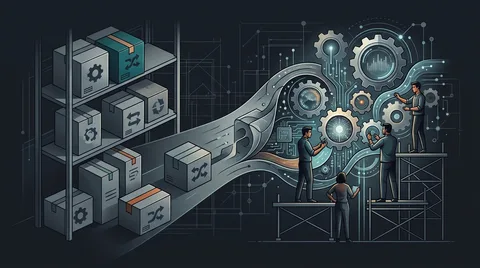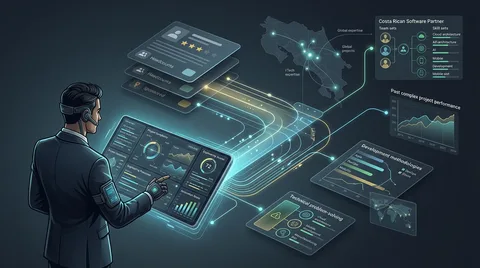


WhatsApp AI automation in Costa Rica delivers commercial value only when engineered as an integrated operational workflow connected directly to core inventory, scheduling, and billing backends, rather than deployed as an isolated conversational chatbot. Deploying conversational interfaces without live system integration creates administrative bottlenecks, where customer inquiries multiply while employees still manually verify data and execute transactions across internal systems.
At a glance
- 12 min read
Ask us about this
Tell us what you are working on. We reply by email.
Discuss Your ProjectThis analysis is written for operational leaders, technical directors, and commercial heads evaluating messaging automation within Costa Rican business operations. It examines the technical architecture, deterministic guardrails, and system plumbing required to turn messaging channels into reliable transaction endpoints.
This guide provides an architectural decision framework based on professional engineering judgment. It does not promise universal efficiency margins, legal compliance, or automated cost reductions. Every business process requires independent scoping, technical validation, and operational oversight tailored to organizational risk tolerance.
The Channel Reality for Business in Costa Rica
Costa Rican commercial communication runs on WhatsApp. Buyers across retail, medical clinics, hospitality, and professional services bypass contact forms and email queues entirely, expecting real-time interaction inside a messaging interface they already check continuously. For an operating company, this consumer habit creates an acute operational bottleneck. Customer support teams spend substantial portions of every workday retyping stock numbers, answering identical pricing inquiries, and scheduling consultations across fragmented internal tools.
Treating Messaging as Core Infrastructure
Navigating this reality requires moving past the concept of a casual chat app. Implementing enterprise WhatsApp AI automation Costa Rica demands treating the messaging channel as a direct operational frontend tied to system APIs. When an inquiry enters the system, an orchestration pipeline must identify user intent, validate account records against internal databases, and branch between automated execution and human support.
Operational leaders cannot rely on isolated conversational scripts that operate apart from inventory counts and booking ledgers. A conversational channel functions productively only when incoming customer messages trigger structured transactional workflows. Integrating the messaging endpoint with core back-office systems allows organizations to scale message volume without inflating operational headcounts or dropping response quality.
The Conversational Trap Versus Operational Integration
Deploying an isolated conversational bot often creates friction instead of eliminating it. Many companies connect generative language models directly to customer channels, expecting natural dialogue to resolve routine inquiries. When an interface cannot verify warehouse stock, validate a tax identification record, or book an appointment ledger directly, it produces polished conversational dead ends. The user receives courteous replies that still require an employee to complete the underlying operational task, effectively doubling communication overhead.
Commercial utility begins when the channel operates as a verified transaction endpoint rather than a chat parlor. Sustainable WhatsApp AI automation Costa Rica demands that incoming customer intents route straight into deterministic backend systems. Natural language parsing should interpret user needs, extract required variables, and hand execution to verified business logic.
A Customer Service Shift Under Peak Demand
When incoming order traffic spikes, an operational messaging channel either processes transactions reliably or collapses under administrative debt. The contrast between unassisted inbox triage and bounded automation becomes obvious during peak hours. The following narrative provides an illustrative example, not a real client, demonstrating how structured workflow design alters a typical business morning.
Illustrative scenario
Managing Morning Peak Inflows
A regional equipment distributor in San José opens its messaging inbox to hundreds of unread queries accumulated overnight. In an unassisted manual model, two service agents spend hours sorting routine questions, manually typing quotes, verifying physical warehouse inventory by phone, and chasing missing delivery locations. Incoming calls go unanswered, delivery promises slip, and complex client requests languish in the queue while staff copy-paste identical product availability details.
By contrast, applying WhatsApp AI automation Costa Rica within defined boundaries transforms the channel into an active routing engine. When overnight inquiries arrive, an automated agent parses incoming text messages, audio notes, and catalog queries. It extracts required variables, checks inventory against the operational database, and returns real-time item status directly into the conversation.
Routine orders and consultation appointments proceed without staff intervention. The automation registers shipping details, validates customer identities against billing records, and generates payment confirmations. Human workers step in only when an edge case appears, such as an unprecedented delivery exception or an unlisted product specification, receiving an organized summary instead of a raw message thread.
An example written for this article. It is not a verified client case.
Architectural Options: Off-the-Shelf Tools vs. Custom Workflow Orchestration
Selecting the technical architecture for WhatsApp AI automation Costa Rica requires balancing immediate deployment speed against long-term operational resilience. Organizations evaluating incoming message channels typically weigh pre-configured SaaS platforms against bespoke orchestration pipelines backed by direct cloud APIs.
| Pre-built SaaS wrappers | Custom API-first orchestration | |
|---|---|---|
| In short | Turnkey software layers offering standard templates, drag-and-drop conversational builders, and bundled messaging connectivity. | Tailored workflow engines connecting messaging gateways to internal systems through controlled middleware and private endpoints. |
| Strengths |
|
|
| Limits |
|
|
Choosing between these paths depends on transactional depth. If WhatsApp serves strictly as an informational FAQ channel, packaged tools handle conversational volume adequately. However, when conversations execute core commerce tasks, verify identities, or write directly to internal company databases, an API-first orchestration model provides the stability and transactional isolation necessary to prevent operational failures.
System Integrations: Connecting CRMs, ERPs, and Local Billing
Executing reliable transactions over chat requires separating conversational processing from core record management. When designing WhatsApp AI automation Costa Rica companies cannot allow an open model to query internal databases directly or invent field payloads. Instead, the architecture relies on an orchestration bridge that translates customer intent into strictly defined, idempotent API calls directed toward enterprise resource planning platforms, customer relation managers, and local electronic invoicing systems.
Read-Side Synchronization and Inventory Holds
Checking product availability involves direct, read-only queries against inventory endpoints rather than static conversational memory. Because catalog stock shifts continuously across retail branches and warehouses, the agent requests real-time stock balances only after parsing clear SKU parameters from the user. When a customer initiates a purchase, the pipeline places a temporary hold on the specified items through the inventory API. This reservation holds the units across a bounded confirmation window, preventing concurrent channel sales from causing stock discrepancies before checkout completes.
Secure Mutations and Invoicing Records
Writing verified customer and order data demands structured validation pipelines. The conversation captures customer identification numbers, delivery parameters, and selected payment confirmations, passing them through validation schemas before triggering system mutations:
- Identity resolution searches the customer database for existing tax numbers, associating the session with historical account profiles or creating a new record through standard REST endpoints.
- Order payloads serialize item arrays, discount validations, and verified branch identifiers into deterministic accounting entries.
- Invoicing connectors transmit verified line items directly to local electronic billing endpoints, returning standard XML receipts and digital documentation directly into the chat session as structured document payloads.
Deterministic Boundaries, Fallbacks, and Human Handover
Deploying conversational endpoints without rigid technical constraints invites unpredictable runtime errors. Language models interpret unstructured text, but they should never calculate prices, confirm inventory availability, or invent policy exceptions. Production-grade WhatsApp AI automation Costa Rica requires deterministic guardrails that separate language understanding from operational decision-making.
Enforcing Operational Guardrails
The orchestration layer must enforce strict interface boundaries between customer intents and back-office databases. When an inbound message requests a transaction, the conversational engine extracts parameters—such as product identifiers or preferred branch locations—and evaluates them against schema validators before calling external endpoints.
If a customer asks for a discount outside predefined promotional matrices, the system rejects the path immediately instead of attempting conversational negotiation. BWAYS establishes autonomy levels based on measured reliability, process criticality, and verified operational risk, allowing permission scopes to expand incrementally as historical execution proves stable.
Graceful Fallbacks and Human Escalation
Uncertainty demands an orderly architectural transition rather than conversational evasion. When input parameters fail validation, or when contextual confidence scores drop below operational thresholds, the pipeline routes the conversation to a fallback handler.
Structured escalation protocols preserve session context, passing parsed entities and execution logs directly to operational staff. An internal service agent receives an enriched ticket containing the verified customer identifier, current basket contents, and the precise failure point. This clean handover eliminates repetitive customer questions and confines autonomous execution strictly to predictable, verified operational envelopes.
Implementation Strategy: From Audit to Phased Rollout
Deploying WhatsApp AI automation Costa Rica requires an incremental release model that ties permissions directly to measured operational reliability. Moving straight from prototype prompts to production autonomy invites transaction errors, inventory mismatches, and customer friction. Engineering leadership must instead establish isolated staging environments, calibrate API payloads, and expand agent scope only when deterministic validation criteria are satisfied.
Step 1: Catalog and permission mapping
System architects audit existing messaging records to categorize customer intents, catalog target enterprise systems, and define field-level read and write permissions. Engineering teams map which database actions require deterministic approval rules and which can run asynchronously. This stage concludes once technical leads document explicit data schemas, system failure modes, and security access boundaries.
Step 2: Sandbox environment and mock payload validation
Software engineers build an isolated staging environment connecting the conversational engine to mocked endpoints representing the inventory, scheduling, and billing systems. Integration testers execute simulated customer dialogues using regional conversational patterns to verify deterministic parser rules and fallback routing. Advancement requires zero uncaught execution exceptions and complete payload schema conformance across all simulated interactions.
Step 3: Supervised pilot with operational staff
Operations teams introduce the system internally to handle live traffic alongside staff acting as reviewers for proposed backend actions. The model drafts structured transactions while human operators confirm or correct payloads prior to external database commitment. The organization moves forward only after logged transaction validation rates consistently satisfy predefined internal service quality thresholds.
Step 4: Limited production rollout and telemetry monitoring
The operational team routes a bounded fraction of incoming messaging volume directly to the integrated workflow while maintaining live fallback desks for immediate exception intervention. Telemetry systems track latency, unparsed entity frequencies, routing accuracy, and human escalation rates in real time. Full operational release proceeds once system monitoring confirms stable transaction completions without unhandled routing deadlocks.
Operational and Governance FAQ
Deploying an automated messaging layer across critical customer touchpoints requires clear policies on oversight, compliance, and systems architecture.
- How is automated agent autonomy governed safely?
- Operational oversight is configured per workflow, transaction type, and demonstrated reliability rather than through an arbitrary all-or-nothing policy. Low-risk operations such as checking inventory availability or confirming standard business hours execute autonomously within strict API bounds. High-consequence requests involving price adjustments, account cancellations, or ambiguous terms route automatically to staff desks alongside conversation history. This tiered permission structure allows autonomy to expand systematically as telemetry proves baseline accuracy.
- How does WhatsApp AI automation Costa Rica handle data privacy compliance?
- Architectures operating locally must respect Costa Rican data protection statutes, notably Law 8968 covering personal information distribution. Customer interactions on messaging platforms often surface national identification numbers, physical addresses, and sensitive payment intent. Production pipelines enforce payload sanitization, strip payment card details prior to persistent logging, and isolate backend database queries behind encrypted access layers. An enterprise should consult a qualified legal adviser to confirm specific data retention schedules.
- What happens when backend systems or ERP connectors experience downtime?
- A production messaging pipeline decouples interface availability from backend execution using message queuing and circuit breakers. If an inventory database or billing engine drops connection, the conversational layer halts transactional promises immediately. Rather than hallucinating availability or throwing fatal syntax exceptions, the agent informs the customer that system synchronization is currently delayed, logs the pending intent into a resilient queue, and alerts engineering desks.
- Can an automated agent initiate outbound notifications to customers?
- Outbound notifications operate under strict channel provider policies and user consent parameters. Platforms restrict outbound contact to pre-approved utility, authentication, or service templates, and recipients must have provided verifiable opt-in permissions. Transaction receipts, delivery tracking notices, and scheduled appointment alerts execute reliably through these structured formats. Arbitrary promotional broadcasting without prior consent risks immediate messaging tier demotion or channel suspension by provider enforcement systems.
- How do systems handle regional linguistic nuances and voice notes?
- Inbound communication in regional markets regularly mixes colloquial vocabulary, regional phrasing, and audio voice messages. Inbound voice notes process through dedicated transcription pipelines before passing to text extraction layers. Structured natural language models extract operational parameters, such as quantities, dates, and catalog references, while discarding conversational filler. Ambiguous or contradictory phrasing triggers deterministic clarification prompts rather than statistical guessing about what the customer intended.
Next Steps: Structuring Your WhatsApp Architecture
Before committing code or subscribing to messaging platforms, technical leadership must define operational perimeters. Effective WhatsApp AI automation Costa Rica initiatives start by cataloging the exact system actions an automated conversational agent can invoke. Treating the chat interface as an API consumer demands the same rigor applied to internal microservices: isolated read endpoints, restricted database write scopes, and explicit state validation.
Establishing Scopes and State Boundaries
Every automation boundary requires three core operational definitions:
- Action Permissions: Map each customer intent strictly to an idempotent API route. Read-only queries handle catalog lookups and order tracking, while writes require verified customer identities.
- Data Minimization: Keep internal enterprise databases separate from conversational session stores. Sensitive records should pass only through ephemeral memory during runtime execution.
- Fail-Safe Routing: Define static routing rules that transfer anomalous payloads or unverified transactions directly to operational staff queues.
Engineering teams maintain system stability when operational permissions expand only after live validation confirms consistent model behavior across business edge cases.